Women by Women

Women by Women, a unique photography exhibition that celebrates female trailblazers and the incredible talent of women photographers around the world, is currently touring Dublin.

Current dates and locations:

  • Rathmines Library: 12th May to 12th June 2022.
  • Ballyfermot Library: 12th June to July 4th 2022.
  • Cabra Library: 4th July – 29th July 2022.
  • Third Space Smithfield – August and September 2022.

If you would like to host this exhibition at another venue, please email: jo-ann.ward at actionaid.org.

The exhibition, developed by ActionAid, showcases women on the frontlines of climate change, and others who have overcome obstacles to become leaders in their community. It highlights women including the Guatemalan hip-hop artist who uses her music to champion feminism and the founder of a non-profit coffee collective in the Democratic Republic of Congo, amongst others.  In addition, all the images were taken by female photographers from the countries in which ActionAid works.

About the photographers:

  • Ina Makosi Is a self-taught photographer and hip-hop activist from Senegal. In 2011, she joined Africulturban, an association dedicated to hip-hop and urban cultures and trained at its first academy where she worked closely with Senegalese film maker Fatou Kandé Senghor. Her aim is also to inspire and empower other female artists in Senegal and offers photography courses to young former prisoners as part her association with Africulturban.
  • Samar Hazboun is a Palestinian photographer whose work has been published by the New York Times, Al-Jazeera, and the Washington Post. She was the winner of the Self-Portrait category in the 11th Pollux Award and won an award from the Khalil Al-Sakakini centre for her project Hush, an exploration of gender-based violence in Palestine.
  • Born in Guatemala City, Morena Perez Joachin initially worked in television before becoming a photographer and photojournalist at the age of 18. Morena’s photographs often focus on women and she is particularly interested in capturing images of indigenous towns in her birth country. She has exhibited in Guatemala, Spain and Chile, and has worked with publications including the German Press Agency dpa.
  • Yen Duong is a Vietnamese photojournalist whose work has been published in Reuters, Bloomberg, the Guardian, the New York Times, and other international news outlets. With a background as an investigative journalist, Yen’s work explores important themes from human trafficking to the impact of rapid urbanisation on marginalised communities.
  • Habiba Nowrose is a photographer based in Dhaka, Bangladesh. She holds an MS in women’s and gender studies from the University of Dhaka and is particularly interested in subjects that explore human relationships and gender identities. Her series, Concealed, was a finalist for the 2018 Invisible Photographers Awards and Samdani Art Award 2020.
  • Esther Mbabazi is a documentary photographer. She uses storytelling and photojournalism to address issues in her society that are often overlooked. Her work explores changing conditions on the African continent, with a focus on the social, economic, physical and emotional aspects of daily life, especially in rural areas and for minority groups. Esther’s work has appeared in publications including The New York Times, TIME magazine and The Observer.
  • Pamela Tulizo started her career as a journalist, but now works primarily as a documentary photographer based in Goma, the Democratic Republic of Congo (DRC). Pamela has led two photography exhibitions in Goma, both focusing on women and their role in society. She has also captured images of the country’s Ebola outbreak for Agence France-Presse (AFP), which were featured on news sites around the world.
  • Etinosa Yvonne is a self-taught documentary photographer and visual artist from Nigeria. Her work explores themes related to the human condition and social injustice. In 2020, Etinosa was one of six people selected for the Africa Edition of the World Press 6X6 Global Talent Program. Etinosa’s work has been exhibited and published internationally.

The exhibition was launched on 27th April in the Mansion House Dublin, hosted by the Lord Mayor. The launch event included a panel discussion on dismantling bias, racism and representation, with contributions from Dr Nita Misha, Deborah Oniah and Dr Sahar Ahmed.

Photo caption: Marcelline Budza is the founder of a non-profit coffee collective in the DRC. Here she shows members articles and photographs about their collective on her mobile phone. Taken by Pamela Tulizo/ActionAid.
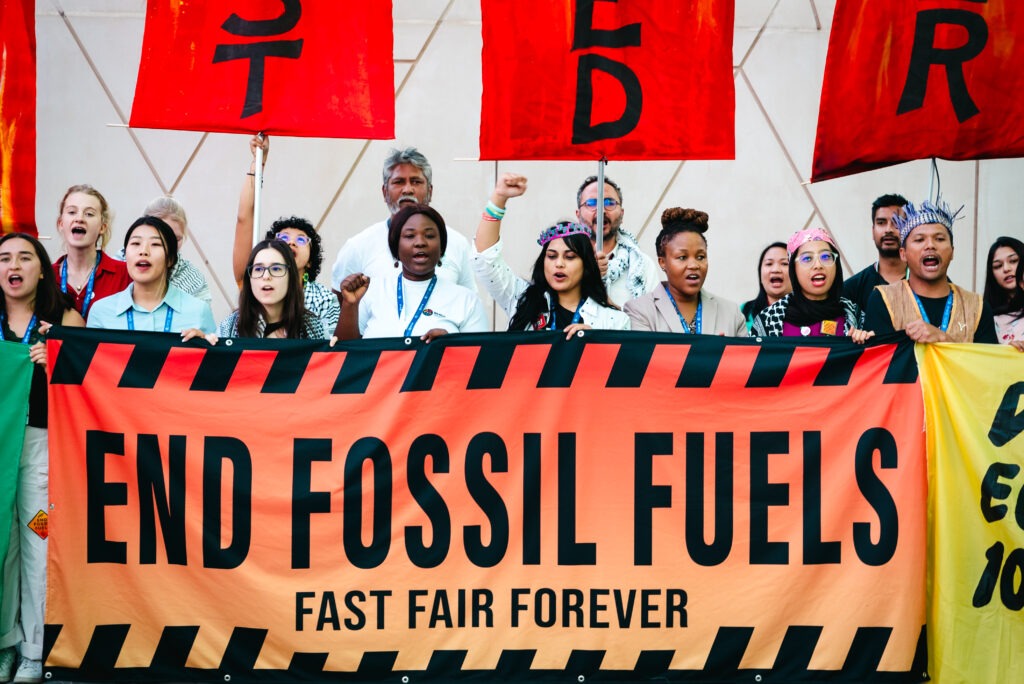
Protesters holding End Fossil Fuels banner at a climate demonstration, advocating for renewable energy solutions.

Protestors at COP 28 in Dubai. Photo: Konrad Skotnicki.

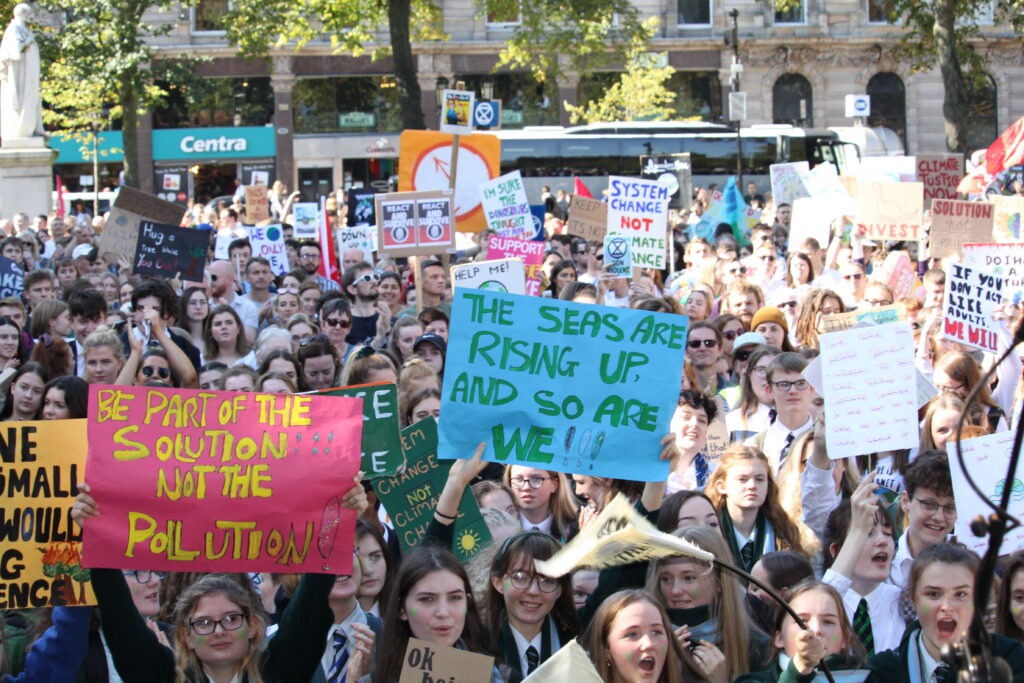
Climate protest with diverse crowd holding signs about environmental action in a city square.

Belfast Climate Change March, 2019. Photo: Trócaire.

The Profit Driving the Crisis

Despite their overwhelming contribution to global emissions, fossil fuel companies continue to attract significant financial backing—driven by their enduring profitability. This is starkly illustrated by the case of ExxonMobil, the top fossil fuel investment held by asset managers based in Ireland. In 2023, ExxonMobil reported €33.63 billion ($36 billion) in profit. That is almost twice the GDP of Botswana (€18.1 billion) and nearly three times Namibia’s GDP (€11.5 billion).

Ireland plays a hugely disproportionate role in facilitating investments into fossil fuel companies like ExxonMobil. In 2023, the investments made into fossil fuel companies by investment managers based in Ireland generated an estimated 72.5 million tons of CO2e. This is more than the CO2e emissions for the entire country of Ireland—and more than ten times that generated by Sierra Leone.

The Global Human Impact

The climate crisis is here, now, and it is causing disproportionate harm in the Global South. In Bangladesh, rising sea levels and increasingly severe cyclones are displacing coastal communities, with projections indicating that 17% of the entire country could be underwater by 2050. The legally binding Paris Agreement on climate change explicitly acknowledges the importance of tackling private finance. Its three overarching goals are: keeping below 1.5C of warming; increasing adaptation and making finance flows consistent with low emissions and resilience.

This gives a clear mandate for action:  both tax reform and corporate regulation are needed to tackle financial flows, and both nationally in Ireland and at EU level, ‘polluter pays’ taxes are lacking and regulation of the financial sector remains weak and fragmented. While EU regulation exists, it is designed more to nudge investors toward more sustainable investment practices by increasing transparency and reporting levels than to enforce strict standards. And it is moving in the wrong direction: the recently passed EU Corporate Sustainability Due Diligence Directive excluded investments; and now the EU Commission’s Omnibus legislative proposal threatens to undo the limited gains made on climate plans, as well as blocking future attempts for stronger action at national level.

The Risk of Inaction

Fossil fuel investment is too profitable to remain weakly regulated. If Ireland continues with its current strategy of encouraging FDI at all costs, and relying on weak EU regulation, we are headed for catastrophe. The Inter-governmental Panel on Climate Change has repeatedly warned that every fraction of a degree beyond 1.5°C brings irreversible consequences: collapsed ice sheets, vanishing coral reefs, and extreme weather events that will make vast regions of the planet uninhabitable. And yet, companies are developing oil and gas fields that could push global warming beyond 2°C.

Our research found that 91% of the investments made into fossil fuel companies by investment managers based in Ireland were to companies that have plans for fossil fuel expansion like these. Ireland cannot afford inaction on this issue.

About This Research

The figures in this report regarding investment from Ireland are based on new research commissioned by ActionAid Ireland and Trócaire. In the paper, we uncover the scale of fossil fuel investment through Ireland, who the investors are, and in which fossil fuel companies they are investing.  We analyse the current regulatory framework and explain why it is inadequate—and moving in the wrong direction. And we make specific recommendations for change, which are summarised below.

Summary of Recommendations

Regulate the private financial sector
Ireland must end its outsized role as an enabler of destructive fossil fuel investment. Ireland should introduce a strong gender-responsive national human rights and environmental due diligence framework which includes the regulation of investors with respect to human rights and the environment and climate. The transposition of the EU Corporate Sustainability Due Diligence Directive could achieve this if downstream activities are included and the Omnibus proposal is rejected. Ireland should prohibit investments in fossil fuel expansion and require investors to implement climate transition plans consistent with a 1.5°C climate limit.

Endorse the Fossil Fuel Non-Proliferation Treaty
Ireland should endorse developing a Fossil Fuel Non-Proliferation Treaty to curb fossil fuel expansion and commit to a fair and funded phase out of fossil fuels.

Support tax justice
Ireland should support bold and fair new global tax rules through the UN Framework Convention on Tax, should adopt all OECD BEPS measures, and should conduct an updated and comprehensive spillover analysis of its tax policy. Ireland should take coordinated action globally, at the EU level and domestically to introduce a range of new taxes to mobilise finance needed for climate justice, based on ‘polluter pays’ and social equity principles such as wealth taxes for the highest earners, climate damages tax on investors, fossil fuel production taxes and levies on aviation and shipping.

Finance a just transition
Ireland must also meet its fair share climate finance obligations under Article 9.1 of the Paris Agreement, and pay our ecological debt to the Global South. Ireland should support conditionality-free debt cancellation for countries on the front lines of the climate crisis, commit to a new UN Framework Convention on Sovereign Debt, moving debt negotiations from the IMF to the UN, and to a debt workout mechanism that is fully representative and fair.

Further reading