
The EU is about to slash and burn corporate environmental standards- Ireland must resist this
Twelve years ago, the collapse of Rana Plaza in Bangladesh killed more than 1,100 garment workers—mostly women—who were sewing clothes for some of Europe’s biggest brands. The international outcry sparked reforms, most notably France’s 2017 “Duty of Vigilance” law, which for the first time imposed legal obligations on French based companies to prevent human rights and environmental abuses throughout their global supply chains.
After Rana Plaza, France led the charge on tackling corporate power. Its duty of vigilance law requires large multinationals to publicly disclose and act on risks in their operations across their value chains globally. France’s leadership spurred momentum across Europe, culminating in the EU’s Corporate Sustainability Due Diligence Directive (CSDDD) which is designed to compel companies to identify, prevent, mitigate, and remedy human rights and climate harms across their entire value chains. It requires accountability through civil liability, involvement of stakeholders, and yearly monitoring.
While the directive is not without its faults—notably the exclusion of the financial sector—it still holds the potential to deliver tangible protections for millions of women working in global supply chains, from garment factories to farms to mines.
It was a hard-won achievement, the result of years of sustained pressure from trade unions, NGOs, women’s rights organisations, and environmental groups across Europe and the world.
The directive faced intense resistance from corporate lobbies and member states and only passed after months of deadlock and political brinkmanship. But today, that hard-won progress is under serious threat—from an EU “Omnibus” proposal that would gut the protections meant to ensure what happened in Rana Plaza, never happens again.
In February 2025, the European Commission unveiled an “urgent simplification” package – the Omnibus proposal. Its logic? To reduce “red tape” and make EU companies more globally competitive.
But look more closely and this is anything but simple. Driven by intense corporate lobbying, the Omnibus proposal strips the CSDDD of its core protections. It limits due diligence requirements to a company’s direct, first-tier suppliers—ignoring the deeper layers of subcontracting where the worst abuses, particularly against women, frequently occur.
It weakens stakeholder involvement by narrowing who must be consulted, effectively sidelining already marginalised voices. Critically, it significantly curtails civil liability, meaning victims would have limited legal routes to hold companies accountable, and it blocks trade unions and NGOs from representing them in court. It also waters down climate obligations by making climate transition plans optional, undermining efforts to address the environmental harm that disproportionately affects communities in the Global South.
This is not about reducing red tape- it is a slash and burn of protections.
One of the most glaring weaknesses in the original CSDDD was the exclusion of the financial sector. While banks, insurers and investment firms were not required to conduct due diligence on their downstream activities—such as loans, investments, and insurance—a review clause offered a chance to revisit this gap in two years’ time.
The Omnibus proposal would scrap that clause entirely, locking in the exemption and eliminating any future prospect of aligning financial flows with the EU’s human rights obligations or the goals of the Paris Agreement. This rollback is particularly dangerous in light of new research from ActionAid and Trócaire, which exposed the staggering scale of harmful finance coming from the financial sector in Ireland. As of June 2024, Irish-based subsidiaries of investment companies held €31.76 billion ($34 billion) in fossil fuel investments.
Much of this has been shielded from scrutiny thanks to unprecedented lobbying from the financial industry—with BlackRock among the most active and influential players pushing to weaken regulation. BlackRock is one of the major investors through Ireland of fossil fuel, despite its public sustainability pledges. The Omnibus, if passed, would ensure such actors remain beyond the reach of meaningful accountability.
These are not just abstract legal tweaks—they translate into real impacts for women globally. In Bangladesh, for example, research shows 80% of female garment workers in Dhaka have witnessed or experienced gender-based violence. With due diligence limited to first-tier suppliers, deeper subcontracting—where such abuses thrive—escapes oversight.
Companies prominent in Ireland—like Pennys, Nike, and H&M—have already been implicated in serious corporate abuse, including wage theft in factories across Bangladesh, Cambodia, and Indonesia, where workers were underpaid during the COVID-19 pandemic.
Without legislation with teeth, corporate profit comes first- and women’s rights, climate change, human rights- all suffer.
The Irish government is sending deeply mixed signals on this issue. In response to recent questions in the Dáil, Ministers have publicly declared their support for the CSDDD. Yet, in the same breath, they express backing for the Omnibus proposal that would effectively gut it.
As recently as June 19, Minister Neale Richmond told the Seanad that Ireland supports “retaining the core elements of the CSDDD”, including full value chain accountability, civil liability, and the implementation of climate transition plans. Yet, a week later the European Council reached a general approach on the CSDDD, which undermines these very elements. This contradiction risks turning Ireland’s stated commitments into empty rhetoric, unless the government acts decisively to defend the directive’s core protections. With trilogue negotiations between the European Commission, Parliament and the Danish Council presidency now underway, Ireland still has an opportunity to align its actions with its words.
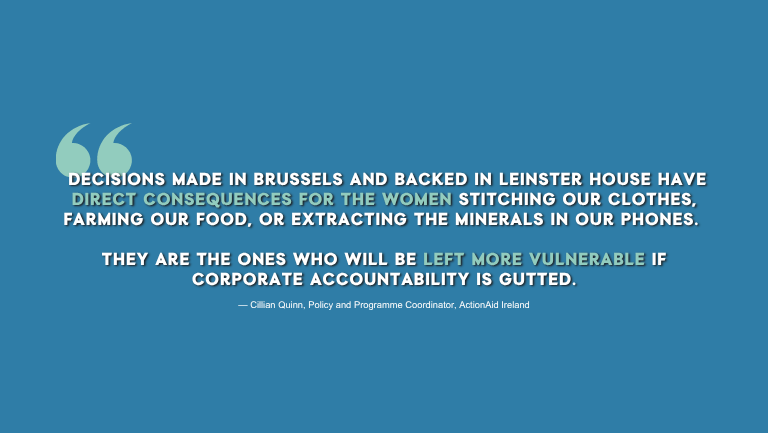
Too often in Ireland, issues like this are condensed into political slogans in messaging to the public, such as “good for business, good for Ireland”, without any honest look at the real cost. But there is nothing abstract about this. Decisions made in Brussels and backed in Leinster House have direct consequences for the women stitching our clothes, farming our food, or extracting the minerals in our phones. They are the ones who will be left more vulnerable if corporate accountability is gutted.
The Irish government must reject the Omnibus rollbacks and defend the core of the CSDDD: binding liability, full value chain accountability, meaningful stakeholder consultation, climate transition plans, and regular monitoring.
But Ireland must also look beyond Brussels. It should introduce a strong, gender-responsive national due diligence law, one that holds Irish companies and investors accountable for their impact on people and the planet and helps drive a just global transition. This must include financial services within Ireland’s foreign direct investment.
We owe it to the women who died in Rana Plaza—and to the millions still working in similar conditions—not to let history repeat itself. Anything less is prioritising profit over people, and silence over justice.
