
COP30: What happened in Belém and what Ireland needs to do next.
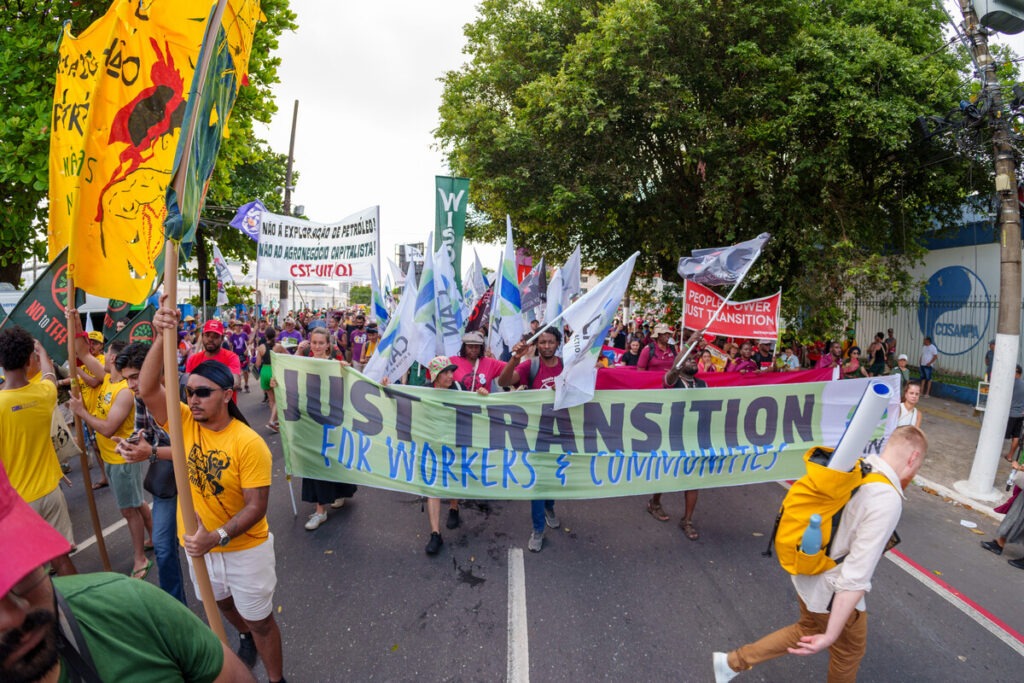
Climate change is one of, if not the biggest crisis shaping our lives. Yet for most people, the negotiations that happen at COP can feel distant, full of jargon, and happening in a world that feels completely distant to us.
So here’s a breakdown of what actually happened at COP30 in Belém — our six big takeaways — and what Ireland must do now if we’re serious about climate justice.
1. The good news – a Just Transition Mechanism.
One of the few bright spots in Belém was agreement on a new Just Transition Mechanism (the “Belém Action Mechanism”). This was a COP decision that puts people’s rights at the centre of climate action — spelling out human rights, labour rights, Indigenous rights and, importantly, gender equality and women’s empowerment at a time of global backlash.
It’s rare to have much to celebrate at COPs these days so we should take this win with all those who fought so hard for the mechanism.
But while the principles are strong, the mechanism doesn’t come with the real, grant-based finance needed to make a just transition happen. Without money behind it, it risks becoming another voluntary promise.
2. The bad news – fossil fuel roadmap collapsed — and the reasons are not as simple as some suggest.
Ireland, along with more than 80 countries, pushed for a clear roadmap to phase out fossil fuels. It didn’t make it into the final text.
Some big fossil fuel producers blocked it, Saudi Arabia, Russia for instance played a huge role — but that’s not the whole story. Many African negotiators felt the version on the table ignored basic fairness: that the richest countries, responsible for the overwhelming share of historic emissions, should go first and fastest and finally deliver the climate finance they’ve promised for years so countries can avoid depending on fossil fuels.
The Irish government is right to be frustrated that the roadmap did not make it into the text, as are we, but Ireland and Europe’s own failure to deliver fair climate finance makes its push for ambition ring hollow.
3. Finance is still flowing to the very industries driving climate change, with Ireland playing a massive role.
We are concerned about the lack of progress at COP30 when it comes to aligning financial flows with the ambition of climate action under article 2.1(c). Since the Paris Agreement, EU-based banks have pumped an average of €40.2 billion every year into fossil fuels and industrial agriculture in the Global South — more than four times what the EU provides in actual grant-equivalent climate finance. Fossil fuel companies in Europe made more than €180 billion in taxable profits over 2022 – 2023 alone, while governments kept over €100 billion a year in fossil fuel subsidies. Europe is not just a heavy consumer of fossil fuels — it is actively profiting from them.
Ireland has its own role to reckon with. Our research found that, as of June 2024, Irish-based subsidiaries of investment companies held €31.7 billion in bonds and shares issued by fossil fuel corporations. This lays bare the great contradiction at the heart of Irelands climate ambition— on the one hand we champion high-quality grant based climate finance, but we are also enabling fossil-fuel expansion on the other. As we begin to look ahead of COP31, this is something we cannot ignore.
4. Finance remains the fault-line — and richer countries are still dodging responsibility
Global South countries came to COP30 looking for clarity on real public climate finance under Article 9.1. What they got instead was a two-year work programme full of process, light on delivery.
The headline promise to “at least triple” adaptation finance sounds good — but there’s no baseline, no new money, and no clarity on who pays. Even worse, the timeline was pushed to 2035, five years later than what climate-vulnerable countries asked for.
And once again, there was no serious conversation about the debt crisis strangling public services and climate responses across the Global South. Just months before COP, states met in Seville under the UN Financing for Development process, where the message was unambiguous: debt is wiping out countries’ ability to respond to climate impacts. That almost entirely disappeared in Belém.
Instead, some governments doubled down on loans and private investment as “solutions” — despite the fact that these only deepen the problem. There are alternatives: wealth taxes, closing corporate loopholes, ending subsidies that fuel the crisis.
5) We saw progress on gender equality, but the backlash was evident across the two weeks.
The Belém Gender Action Plan was adopted, which is a real win and gives the UNFCCC gender work a nine-year runway. But this COP also saw coordinated attempts to dilute or re-define gender language, mirroring what we are seeing across multilateral spaces. The plan survived — but the attacks will likely gain traction in line with a rise in anti-gender movements. We need Ireland to stay vigilant and consistently defend agreed gender language across all tracks in 2026.
6) False solutions to the climate crises continue to play a troubling role.
Ahead of COP30 we were concerned about the growing calls for quick fixes and market-led “solutions” that don’t cut emissions and don’t protect communities.
The Tropical Forest Forever Facility (TFFF) did receive political oxygen amassing pledges of more than $6 billion. The reality is public finance is scarce and needs to go directly to forest communities rather than to complex financial instruments that aren’t guaranteed to raise money or benefit people on the ground. The initiative is a gamble in the casino of financial markets and is based on increasing the burden on countries that are already in debt distress and constantly battling climate-induced disasters. This is a contradiction to the principles of fair climate finance.
The push for market-friendly fixes is not going away, so Ireland will need to stay alert to these proposals as we move into the COP31 cycle and champion genuine climate action, not distractions driven largely by corporate interests.
Our overall takeaway
We urgently need a global phase-out of fossil fuels. But that won’t happen unless countries in the Global South have the public, grant-based finance to mitigate, adapt, and deal with the loss and damage already hitting them.
And Ireland — especially as we will hold the EU Presidency heading into COP31 — has an important role to play.
What Ireland needs to do next
To show real leadership, Ireland must:
1. Defend and operationalise the new Just Transition Mechanism
– and make sure it comes with ambitious, grant-based funding.
2. Double down and scale up, public, grants-based climate finance
– and push the EU to follow suit. Loans and private investments are not a substitute.
3. Confront the contradictions in our own financial system
– by addressing the huge flow of Irish-based investment into fossil fuel expansion.
4. Stand firm on gender equality
– pushing back against the growing anti-gender movement across negotiations.
5. Reject false solutions
– including biofuels, risky financial schemes, and carbon offsetting — and champion real climate action that actually cuts emissions and protects communities.
