Genet Shume: Fighting for gender equality

My name is Genet Shume and I am the programme director for ActionAid Ethiopia. I am passionate about women’s rights and justice for women. I studied law as my first degree and worked for the Ethiopian Women Lawyers Association, and then the Federal Supreme Court Child Justice Project Office, before joining ActionAid. We provided free legal aid for women, girls, and children deprived of justice.

Since then, I have worked on advocacy and policy around issues affecting women, especially gender-based violence.

There have been improvements in relation to GBV in Ethiopia, with legislation and policies in place, and more women’s rights organisations. But there is a long way to go and the government still has to make critical commitments, including funding women’s rights and ensuring that the needs of GBV survivors are met. This is an area in which I believe we need to advance more.

As well as GBV, women face economic injustice, especially in a relationship or a marriage where women are mostly dependent on the income of their partners. Even when there is violence in a relationship, women stay silent as they need to have their children fed. Social norms can have a negative impact on human rights- girls are told to prepare for marriage and not to engage in employment, limiting their education engagement and progress as well, leading to economic dependency.

Women often work in cities, but are still expected to take care of the household and community commitments of care. They also face GBV or domestic violence even as bread winners.

There is poor accountability for women and girls’ rights violation in general. Perpetrators can be released on bail for their crimes, and the burden of proof is mostly on survivors. Because of this, few cases are reported, and cases that are reported have a low chance of succeeding because the survivor has so much to do to prove guilt. There must be a more survivor-centered and caring system to ensure proper reporting, and a stronger trust in the system from the  community.

There is also growing abuse and harassment of women online and this is harder to prove, prevent and respond to.

ActionAid’s Irish Aid-funded Women’s Rights Programme empowers communities – working with women to change their lives. Women, girls and marginalised community groups learn about their rights and how to use their voices collectively.

This is making a difference. There are many stories of women and girls who are now organised in groups, sharing power, supporting each other and advancing their agenda with local officials and  leaders. We have more women and girls boldly speaking out and challenging systems.

We also have many partners working with us for the same cause, and we collectively address issues. We are engaging local and national governments on gender justice issues including drafting gender policies, and developing economic justice and GBV-related strategies.

Funding from Irish Aid and other donors is making a big difference. It gives us a chance to try new things to challenge existing norms and issues that perpetuates GBV.

Global solidarity and commitments to end gender inequality and injustices are important.  It helps us to work at the national level and address gaps in funding and action.  
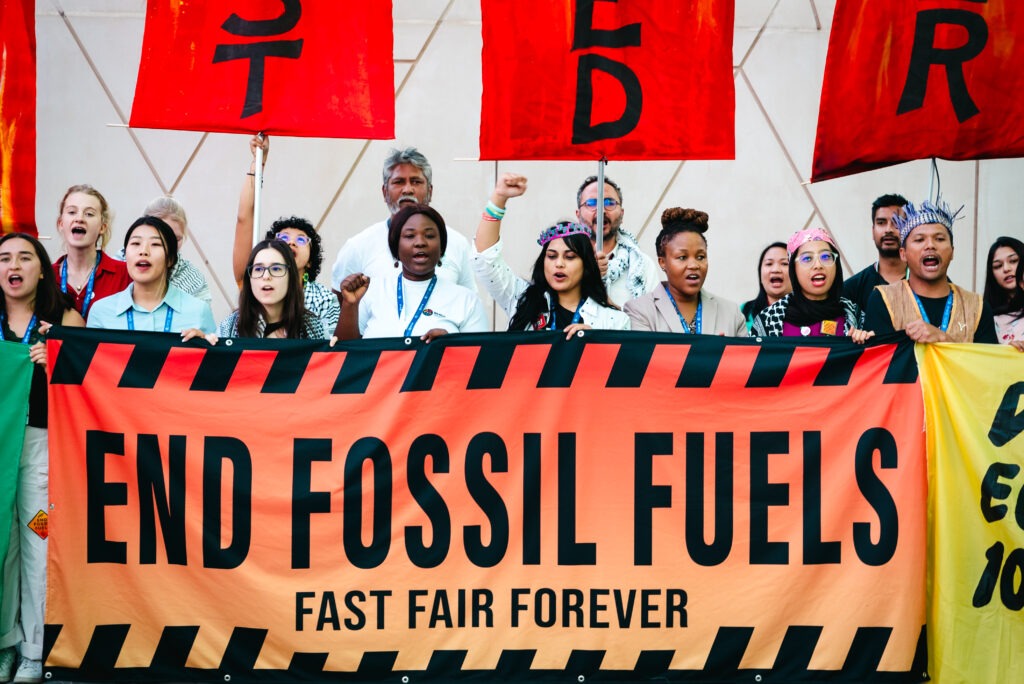
Protesters holding End Fossil Fuels banner at a climate demonstration, advocating for renewable energy solutions.

Protestors at COP 28 in Dubai. Photo: Konrad Skotnicki.

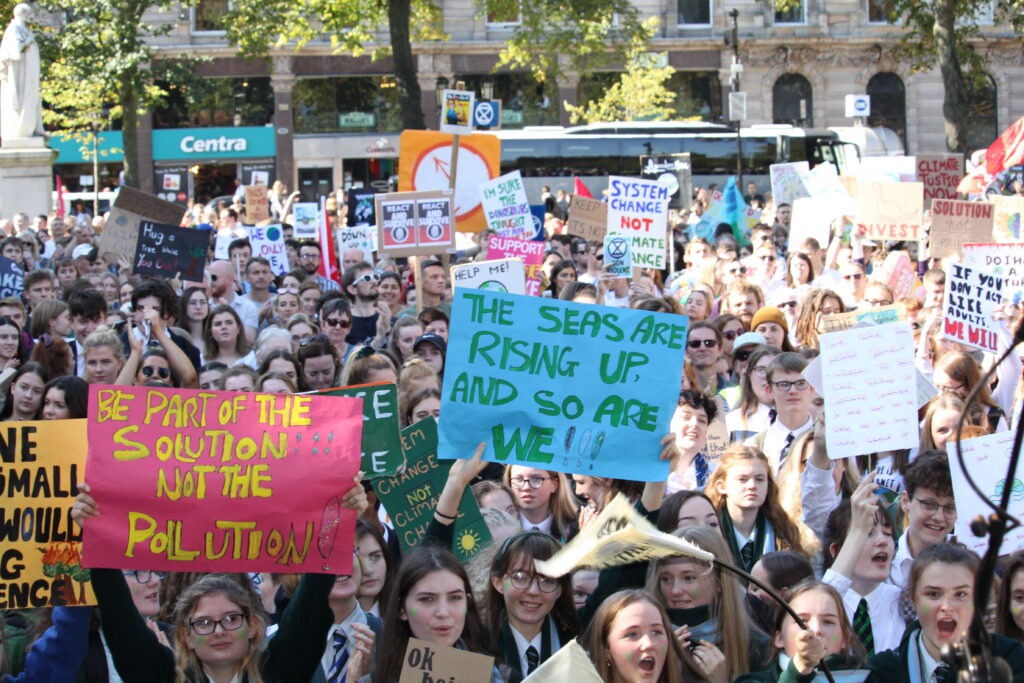
Climate protest with diverse crowd holding signs about environmental action in a city square.

Belfast Climate Change March, 2019. Photo: Trócaire.

The Profit Driving the Crisis

Despite their overwhelming contribution to global emissions, fossil fuel companies continue to attract significant financial backing—driven by their enduring profitability. This is starkly illustrated by the case of ExxonMobil, the top fossil fuel investment held by asset managers based in Ireland. In 2023, ExxonMobil reported €33.63 billion ($36 billion) in profit. That is almost twice the GDP of Botswana (€18.1 billion) and nearly three times Namibia’s GDP (€11.5 billion).

Ireland plays a hugely disproportionate role in facilitating investments into fossil fuel companies like ExxonMobil. In 2023, the investments made into fossil fuel companies by investment managers based in Ireland generated an estimated 72.5 million tons of CO2e. This is more than the CO2e emissions for the entire country of Ireland—and more than ten times that generated by Sierra Leone.

The Global Human Impact

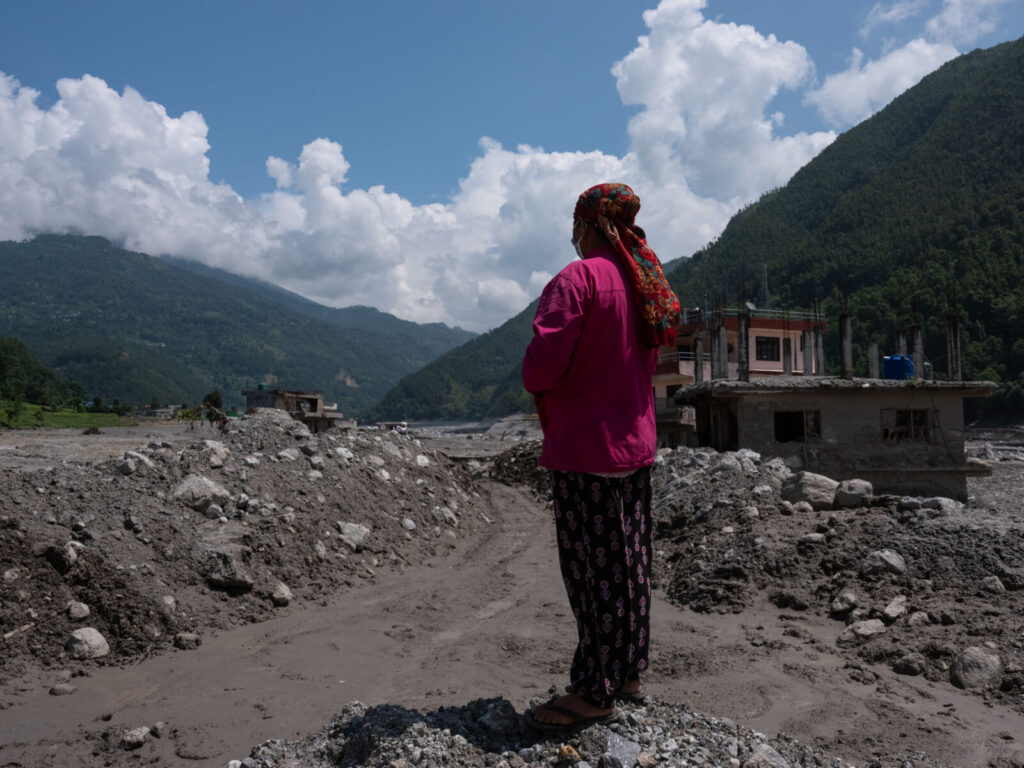
The climate crisis is here, now, and it is causing disproportionate harm in the Global South. In Bangladesh, rising sea levels and increasingly severe cyclones are displacing coastal communities, with projections indicating that 17% of the entire country could be underwater by 2050. The legally binding Paris Agreement on climate change explicitly acknowledges the importance of tackling private finance. Its three overarching goals are: keeping below 1.5C of warming; increasing adaptation and making finance flows consistent with low emissions and resilience.

This gives a clear mandate for action:  both tax reform and corporate regulation are needed to tackle financial flows, and both nationally in Ireland and at EU level, ‘polluter pays’ taxes are lacking and regulation of the financial sector remains weak and fragmented. While EU regulation exists, it is designed more to nudge investors toward more sustainable investment practices by increasing transparency and reporting levels than to enforce strict standards. And it is moving in the wrong direction: the recently passed EU Corporate Sustainability Due Diligence Directive excluded investments; and now the EU Commission’s Omnibus legislative proposal threatens to undo the limited gains made on climate plans, as well as blocking future attempts for stronger action at national level.

The Risk of Inaction

Fossil fuel investment is too profitable to remain weakly regulated. If Ireland continues with its current strategy of encouraging FDI at all costs, and relying on weak EU regulation, we are headed for catastrophe. The Inter-governmental Panel on Climate Change has repeatedly warned that every fraction of a degree beyond 1.5°C brings irreversible consequences: collapsed ice sheets, vanishing coral reefs, and extreme weather events that will make vast regions of the planet uninhabitable. And yet, companies are developing oil and gas fields that could push global warming beyond 2°C.

Our research found that 91% of the investments made into fossil fuel companies by investment managers based in Ireland were to companies that have plans for fossil fuel expansion like these. Ireland cannot afford inaction on this issue.

About This Research

The figures in this report regarding investment from Ireland are based on new research commissioned by ActionAid Ireland and Trócaire. In the paper, we uncover the scale of fossil fuel investment through Ireland, who the investors are, and in which fossil fuel companies they are investing.  We analyse the current regulatory framework and explain why it is inadequate—and moving in the wrong direction. And we make specific recommendations for change, which are summarised below.

Summary of Recommendations

Regulate the private financial sector
Ireland must end its outsized role as an enabler of destructive fossil fuel investment. Ireland should introduce a strong gender-responsive national human rights and environmental due diligence framework which includes the regulation of investors with respect to human rights and the environment and climate. The transposition of the EU Corporate Sustainability Due Diligence Directive could achieve this if downstream activities are included and the Omnibus proposal is rejected. Ireland should prohibit investments in fossil fuel expansion and require investors to implement climate transition plans consistent with a 1.5°C climate limit.

Endorse the Fossil Fuel Non-Proliferation Treaty
Ireland should endorse developing a Fossil Fuel Non-Proliferation Treaty to curb fossil fuel expansion and commit to a fair and funded phase out of fossil fuels.

Support tax justice
Ireland should support bold and fair new global tax rules through the UN Framework Convention on Tax, should adopt all OECD BEPS measures, and should conduct an updated and comprehensive spillover analysis of its tax policy. Ireland should take coordinated action globally, at the EU level and domestically to introduce a range of new taxes to mobilise finance needed for climate justice, based on ‘polluter pays’ and social equity principles such as wealth taxes for the highest earners, climate damages tax on investors, fossil fuel production taxes and levies on aviation and shipping.

Finance a just transition
Ireland must also meet its fair share climate finance obligations under Article 9.1 of the Paris Agreement, and pay our ecological debt to the Global South. Ireland should support conditionality-free debt cancellation for countries on the front lines of the climate crisis, commit to a new UN Framework Convention on Sovereign Debt, moving debt negotiations from the IMF to the UN, and to a debt workout mechanism that is fully representative and fair.

Further reading