Eye-witness account from Haiti

Triona Pender, Head of Programmes at ActionAid Ireland, has been supporting the team in ActionAid Haiti with their response following the devastating 7.2 magnitude earthquake which hit last month.

Distribution in Roseaux following the earthquake

I visited a community called Roseaux, the specific area we visited was called Jake and this is located in the department of Grand Anse in Haiti, it is one of the areas most affected by the 7.2 earthquake that struck the country on 14th August.

I was out to help with an ActionAid distribution. We were delivering hygiene kits. These consisted of soap, washing powder, sanitary towels, toothbrush and toothpaste, toilet paper and chlorox and aqua tabs to purify water. The kits are delivered in a plastic bucket rather than a plastic bag, which can be reused. We also distributed the equivalent of around €200 to families whose homes had been completely destroyed by the earthquake. They can now invest in rebuilding some kind of shelter for themselves.

Make a donation here

The situation is Haiti prior to the earthquake was already dismal. 80% of the population of almost 12 million living in poverty, with 60% living on less than €1 per day. Families in areas like Grand Anse were already food insecure and in receipt of food relief from the World Food Programme and ActionAid; then came the earthquake which destroyed or damaged almost 130,000 homes; a day later, torrential rains from Cyclone Grace washed away the temporary shelters they had constructed. People here are desperate. I had heard of people blocking aid convoys on the road as they are so tired of waiting for support and are frustrated at seeing trucks passing them by when they are also in dire need. I didn’t really know what to expect with our recent distribution; we are the only NGO present in our operational communities.

The Women’s Safe Space

I was a bit taken aback when we pulled into the yard of the Women’s Safe Space office to see people waiting patiently for us and not rushing towards the car. The Local Women Leaders that manage and lead ActionAid’s humanitarian response jumped into action to help us unload the back of the pick-up. We took the supplies into a room at the back of the office. Here, they quickly and efficiently organised the supplies into individual buckets. They were a group of young women who have been trained by ActionAid. And they worked with us in both our emergency response work and our long-term development work.

Meanwhile, the head of ActionAid’s partner (Organisation Femme De Tetes Ensemble de Grand Anse (OFTAG), assisted my colleague from ActionAid Haiti in organising the cash envelopes. They checked the names on identification cards provided by the women against a list of most at-risk people already provided by OFTAG. At the same time, two other members of OFTAG and ActionAid’s young women community ‘mobilisers’ gave a short training to recipients of the aid on Covid prevention and on protection against Gender Based Violence (GBV). They ensured that recipients understood where to report cases and that the Women’s Safe Space will give them a place to stay and help them if they need it.

Impact of the earthquake

After the training the distribution took place and everyone went off “home”. We had stopped at the homes of many programme participants on the way to the distribution. I can’t even describe properly the misery I saw. People are sleeping under a tarpaulin held up with sticks. Or in their kitchens (which are separate from the rest of the house and not made with blocks so the structure is safer). I saw elderly couples, pregnant women, tiny children living in these conditions with their house on the ground in a pile of blocks and stones beside them. Or, just as bad, houses still standing but with huge cracks in the walls and floors and completely unsafe. Some families are sleeping the local school buildings (the ones that haven’t fallen) but school should reopen in a few days in September so what will happen then?

Training Local Women

I spoke to the leaders of OFTAG, all local Haitian women, and asked them why they partnered with ActionAid? They said it’s because with ActionAid, women are not only on the beneficiary list, they are doing the needs assessments, making the decisions and leading the response. I saw that too with my own eyes last Friday. ActionAid have trained these and many other women to work in emergencies and empowered them. But they lack resources and are in need to funds to truly be in a position to manage the response. ActionAid has been working with women and men in these communities for many years. They said we are the only organisation that puts women “in front”.

When I asked them about the current needs of women here, the first thing they mentioned was food, then shelter. There is no support for parents currently who are sleeping in the schools. They need funds and support to re-start their small businesses so that they can support their families. They also need to rebuild homes for protection. Women are especially in danger of violence when living in conditions like these. And they need to “build back better” so that when the next storm or earthquake comes their homes can withstand the pressure.

ActionAid with the support of our generous supporters is responding to those in most need. But, there is still a long way to go to make these communities safe. We will continue to work with local women’s organisations in the recovery and reconstruction phase to help them rebuild their lives.
Please, donate now.

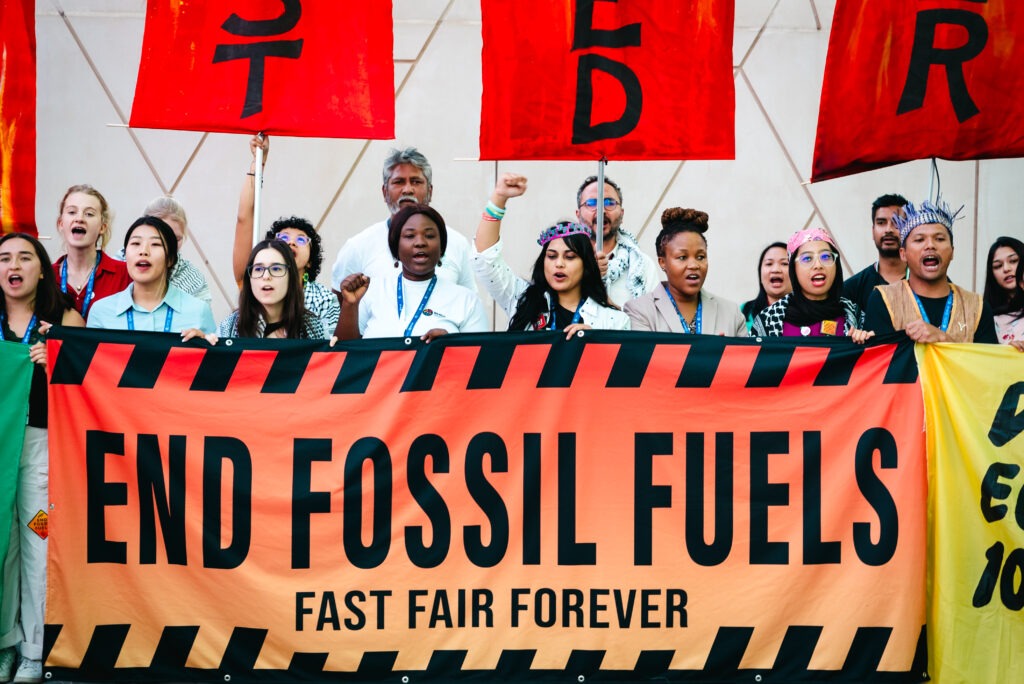
Protesters holding End Fossil Fuels banner at a climate demonstration, advocating for renewable energy solutions.

Protestors at COP 28 in Dubai. Photo: Konrad Skotnicki.

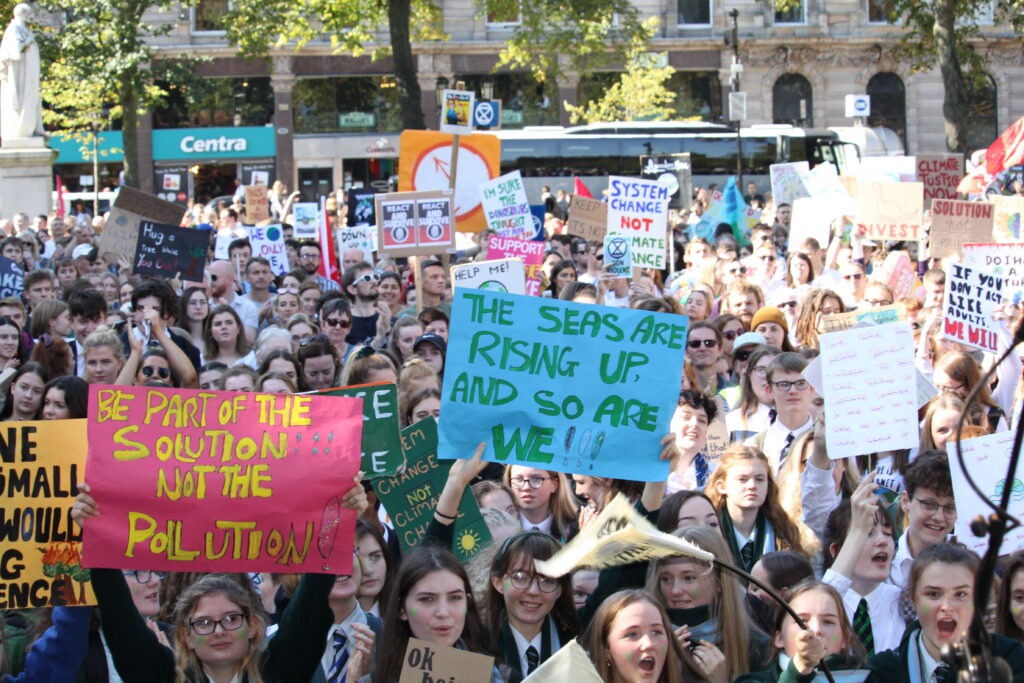
Climate protest with diverse crowd holding signs about environmental action in a city square.

Belfast Climate Change March, 2019. Photo: Trócaire.

The Profit Driving the Crisis

Despite their overwhelming contribution to global emissions, fossil fuel companies continue to attract significant financial backing—driven by their enduring profitability. This is starkly illustrated by the case of ExxonMobil, the top fossil fuel investment held by asset managers based in Ireland. In 2023, ExxonMobil reported €33.63 billion ($36 billion) in profit. That is almost twice the GDP of Botswana (€18.1 billion) and nearly three times Namibia’s GDP (€11.5 billion).

Ireland plays a hugely disproportionate role in facilitating investments into fossil fuel companies like ExxonMobil. In 2023, the investments made into fossil fuel companies by investment managers based in Ireland generated an estimated 72.5 million tons of CO2e. This is more than the CO2e emissions for the entire country of Ireland—and more than ten times that generated by Sierra Leone.

The Global Human Impact

The climate crisis is here, now, and it is causing disproportionate harm in the Global South. In Bangladesh, rising sea levels and increasingly severe cyclones are displacing coastal communities, with projections indicating that 17% of the entire country could be underwater by 2050. The legally binding Paris Agreement on climate change explicitly acknowledges the importance of tackling private finance. Its three overarching goals are: keeping below 1.5C of warming; increasing adaptation and making finance flows consistent with low emissions and resilience.

This gives a clear mandate for action:  both tax reform and corporate regulation are needed to tackle financial flows, and both nationally in Ireland and at EU level, ‘polluter pays’ taxes are lacking and regulation of the financial sector remains weak and fragmented. While EU regulation exists, it is designed more to nudge investors toward more sustainable investment practices by increasing transparency and reporting levels than to enforce strict standards. And it is moving in the wrong direction: the recently passed EU Corporate Sustainability Due Diligence Directive excluded investments; and now the EU Commission’s Omnibus legislative proposal threatens to undo the limited gains made on climate plans, as well as blocking future attempts for stronger action at national level.

The Risk of Inaction

Fossil fuel investment is too profitable to remain weakly regulated. If Ireland continues with its current strategy of encouraging FDI at all costs, and relying on weak EU regulation, we are headed for catastrophe. The Inter-governmental Panel on Climate Change has repeatedly warned that every fraction of a degree beyond 1.5°C brings irreversible consequences: collapsed ice sheets, vanishing coral reefs, and extreme weather events that will make vast regions of the planet uninhabitable. And yet, companies are developing oil and gas fields that could push global warming beyond 2°C.

Our research found that 91% of the investments made into fossil fuel companies by investment managers based in Ireland were to companies that have plans for fossil fuel expansion like these. Ireland cannot afford inaction on this issue.

About This Research

The figures in this report regarding investment from Ireland are based on new research commissioned by ActionAid Ireland and Trócaire. In the paper, we uncover the scale of fossil fuel investment through Ireland, who the investors are, and in which fossil fuel companies they are investing.  We analyse the current regulatory framework and explain why it is inadequate—and moving in the wrong direction. And we make specific recommendations for change, which are summarised below.

Summary of Recommendations

Regulate the private financial sector
Ireland must end its outsized role as an enabler of destructive fossil fuel investment. Ireland should introduce a strong gender-responsive national human rights and environmental due diligence framework which includes the regulation of investors with respect to human rights and the environment and climate. The transposition of the EU Corporate Sustainability Due Diligence Directive could achieve this if downstream activities are included and the Omnibus proposal is rejected. Ireland should prohibit investments in fossil fuel expansion and require investors to implement climate transition plans consistent with a 1.5°C climate limit.

Endorse the Fossil Fuel Non-Proliferation Treaty
Ireland should endorse developing a Fossil Fuel Non-Proliferation Treaty to curb fossil fuel expansion and commit to a fair and funded phase out of fossil fuels.

Support tax justice
Ireland should support bold and fair new global tax rules through the UN Framework Convention on Tax, should adopt all OECD BEPS measures, and should conduct an updated and comprehensive spillover analysis of its tax policy. Ireland should take coordinated action globally, at the EU level and domestically to introduce a range of new taxes to mobilise finance needed for climate justice, based on ‘polluter pays’ and social equity principles such as wealth taxes for the highest earners, climate damages tax on investors, fossil fuel production taxes and levies on aviation and shipping.

Finance a just transition
Ireland must also meet its fair share climate finance obligations under Article 9.1 of the Paris Agreement, and pay our ecological debt to the Global South. Ireland should support conditionality-free debt cancellation for countries on the front lines of the climate crisis, commit to a new UN Framework Convention on Sovereign Debt, moving debt negotiations from the IMF to the UN, and to a debt workout mechanism that is fully representative and fair.

Further reading